
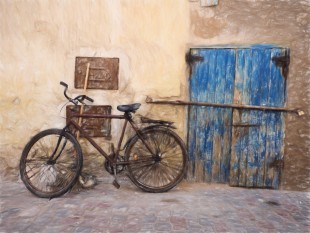
There seemed to be an abundance of bicycles in Essaouira, mostly propped up against walls in the old town. I liked the almost monochromatic (brown) feel punctuated by the decayed blue of the door (blue is a popular colour in Essaouira). I applied a little treatment to give it a more painterly feel.
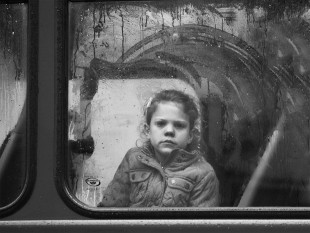
It was a damp day in London and I was looking for things to photograph outside of the Bank when a bus pulled up. The windows were wet on the outside and had condensation on the inside but I could see a young girl staring out. She caught my eye and she saw me point the camera. This was that moment.
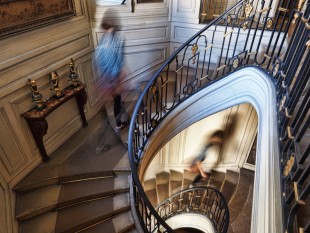
A shot from the Musée Nissim de Camondo in Rue de Monceau, Paris. It was the private home of a Parisian banker who was a passionate collector of French furniture and art objects from the eighteenth century. This is one of the staircases. I like the shape of the stairs but felt I needed something more in the image. Visitors were wandering up and down the stairs and so I support my camera on the handrail at the top of the stairs and waiting for people to fill the gaps. I tried various shutter speeds and decide that 1/2s was going to give me the right amount of blur. I really wanted two people in the appropriate places but had to shoot them individually and combine them in Photoshop.

Wymondham Dickensian Steampunk Fayre in November 2013. I saw this couple walking in Market Place and asked if I could take their photo. I found a nearby doorway and quickly posed them. To finish the image, I desaturated it a little.

Taken in Lyon. I liked the diffusion of the frosted glass of the bus shelter and the fact that the legs and feet were sharp below the frosted glass. Their heads were hidden by an empty grey panel presumably there to take advertising. I wanted something to fill the board. Just 2 minutes away around the corner was a closed-down café with grafitti and paintings on it. Above the window, there were three painted heads. It just shouted at me that these were the heads that should be behind that bus shelter.
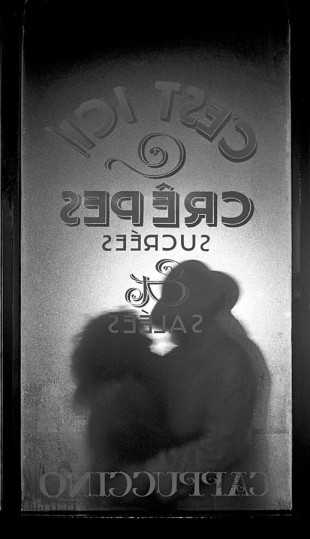
Two lovers outside a café on a cold winter’s night seen through the café window. Shot in monochrome on medium format (Yashicamat 124G) to create the mood of the Trevor Howard and Celia Johnson film of the same name. Taken in 1999 but the date doesn’t matter – this image has a timeless feel. I knew what I wanted before I took it and sketched it out before enrolling two friends to be my models. It could have been taken in Paris but it was actually taken in Cambridge.
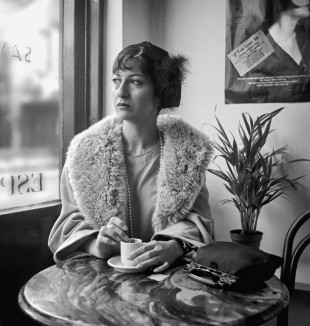
Staring out of the window as she idly stirs her coffee wondering whether her lover has missed the train or…
So many thoughts cross her mind.

Taken in Baker Street at Pride London in 2009. He only held that expression for an instant but it was long enough. The guy in the background nicely fills the corner with a similar look but toned and a little softer so it doesn’t impact too much on the foreground figure.
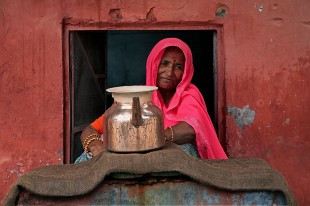
These ladies sit in little huts along the streets offering water to those desperate for a drink when temperatures approach the 40s. I particularly liked the strong colours in this shot.